Weekly Blog Posts

Week #23: Chasing that cheddar

Deck coverMonths ago, we started working on our pitch deck to express our vision, define our business model, and fund our company. It looks great and tells a compelling story. So, I’ve included select slides here.

In a nutshell, our deck starts by explaining the way it was — back when flour was a staple of our health and the cornerstone of healthy local food systems.
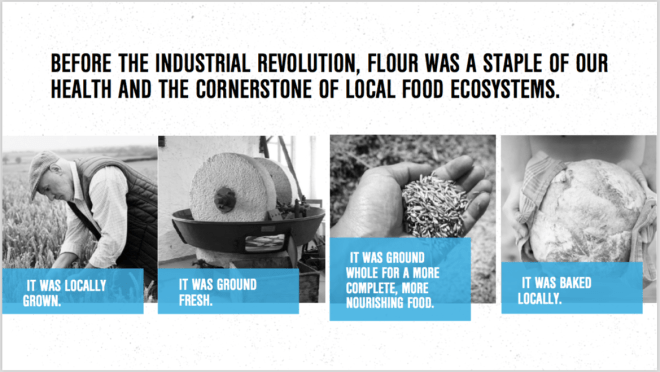
Deck slide - local food systems

Then, we explain how industrialization and consolidation created wheat and flour that’s empty in nutrition, taste and soul. From there, we dig into the category and market opportunity with data that indicates there’s a massive opportunity for a company to build a brand around a local supply chain and by milling fresh flour.
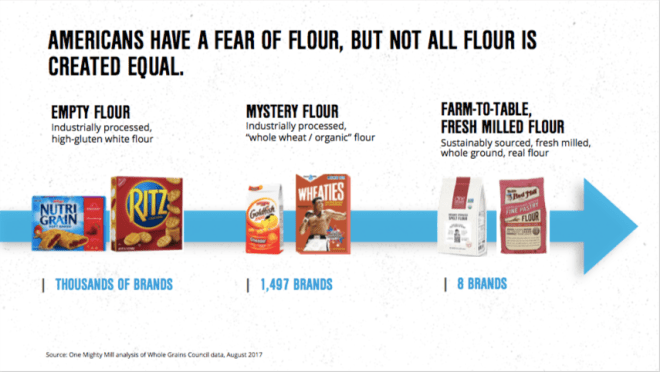
Flour landscape

Next, we introduce our products, packaging, and vision for new product extensions into categories like pasta, cereal and crackers. Our go-to-market strategy is all about winning shelf-space at Whole Foods and building mills in their eastern markets. Finally, we end it with our pro-forma to present the business’ financial viability with some detailed economics.

It took us weeks to complete the deck. And since the first presentation, it’s been a fluid, work in progress that’s been improved by feedback in our meetings.

At this point, I’ve been pitching it for about a month to raise the money required to build the mill and start the business. At the start, you’re completely fired up to finally be able to present the dream. And while it’s been weeks of basically saying the same thing over and over, I do think I’m energized in every meeting. We’ve got something important to say and it comes from a real place. So, I think the passion is clear when I’m presenting.

Anyway, we kicked it off with a few of the most prestigious VC firms in Boston. We don’t want institutional money. But, we did want their feedback and validation. Specifically,  we wanted to hear from the smartest people in food and to test our plan with some of the harshest critics.
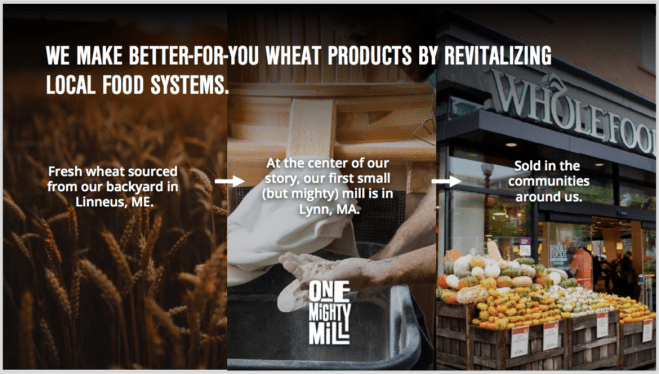
Deck value chain

Since then, I’ve pitched everywhere: on the phone, in big offices, in people’s living rooms after their kids went to bed, in countless coffee shops etc. I’ve pitched all over NYC, Boston, Maine, and the places in between. (One cool highlight was presenting to Gary Vaynerchuck’s team in NY. He’s a legendary entrepreneur and social media mogul.)

The whole process has been reaffirming. I’m certain that our idea is right and opportunity is big. I’m also confident that we can raise the capital we need to do it.

Most importantly, it has reaffirmed what I wanted to do from the start — build a team of people who believe in the same thing.  So, the partners who’ll invest in One Mighty Mill will all be playing the long game. They’ll believe in the shared commitment to build an enduring, special company that makes a difference and makes us proud. Founders get worried about control. The fundraising process reminded me that ultimate control is having a team of people who care about the same thing and trust each other to do what’s right.

Week #22: Our mighty mill

Our mill2There have been plenty of exciting moments so far on the journey to build One Mighty Mill. But, this one was huge.

In that photo above, we’re in Andrew’s workshop. He’s the baker and mill-builder who I met for the first time 5 months ago. Since he wouldn’t respond to my incessant emails and calls, I spontaneously drove 4 hours into the Vermont woods and showed up at his house uninvited and unannounced. It was the first time I’d ever seen a mill in person actually operate and produce flour. While I didn’t really know what I was doing, I did know that a stone mill was the linchpin to “wheat you can eat”. And even though we didn’t have a clear business model, we knew that a mill was the heart and soul of the new food company we needed to start. So, on that day 5 months ago and right on the spot, I asked Andrew to build us a mill. Then, I asked him to build us the biggest one he’d ever built.

5 months later, Andrew was finished. We went to pick it up this week.

In the photo, I’m in the middle and flanked by the builders, Andrew and Anthony. My friend, J.J., who owns a moving company, is on the far left. J.J. and I trucked up to Vermont to bring our mill back home to Boston.

If you look closely, you can see that everyone in the photo is smiling except me. I have this awkward, uneasy expression. That’s exactly how I felt. All the excitement from finally seeing our mill in person was completely neutralized by the anxiety of the sudden, undeniable verification that there was no turning back. We had officially taken the all-important leap to make our vision real. Our mill was freaking massive. So, it’s intimidating to take possession of a 7 foot, 5,000 pound mill that you don’t know how to operate. It got even more intimidating when I watched Anthony and Andrew use a chain and pulley to crank up the 1,200 pound stones and then, disassemble the mill. Since I’m pretty much mechanically incompetent, it was all I could do to not envision myself being crushed by the stones while trying to put the mill back together.

Moving Millstone

Anyway, the move took us the entire day. With a forklift and some heavy grunting, we got the stones and all the parts into J.J.’s truck. Late that night, we successfully put our mill in storage at J.J.’s warehouse.

It’s official: we have our mighty mill. Time to start building a place to put it.

millstone

Week #21: Pray for us, Sister Nancy

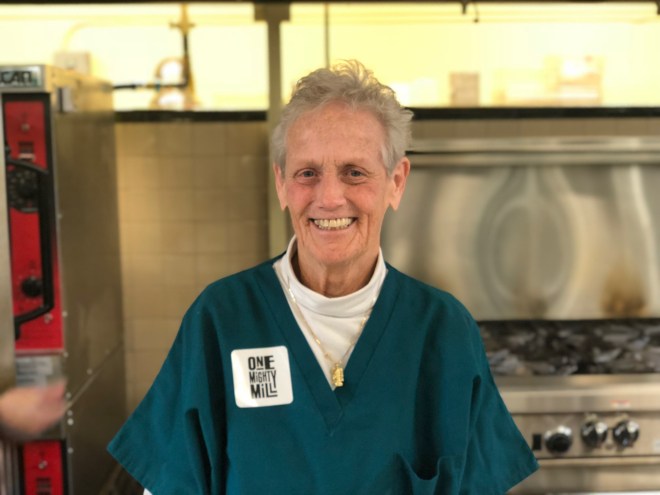
Sister NancyThat’s Sister Nancy.

She goes by “Sister” because she’s a nun.

Sound crazy, but we work with her every Wednesday morning. (Of all the things I could’ve imagined I’d be doing when I left my company 6 months ago, I’d never have fathomed the possibility that I’d be rolling out bagels next to a nun at 5:30a.m.)

It’s not normal. But, it’s a pretty awesome quirk that’ll always be a part of our business’ origin story. Even better, I take it as a sign that One Mighty Mill has the holy spirit on our side.

Let me clarify. Sister Nancy doesn’t work for One Mighty Mill nor is she helping us with product development (outside of being a loyal taste-tester). As noted in previous blog posts, we’ve been cooking and testing recipes twice a week for the last few months. So, Nancy runs the “commercial” kitchen where we’ve been renting space for our testing. And by “commercial”, I really mean a local High School cafeteria. It’s a school that’s just a couple of blocks from my apartment and the one where I’m volunteering to teach this class on entrepreneurship to a great group of high school kids from Boston’s underserved neighborhoods. Since it’s all about applied learning (i.e. education through experiences), the cafeteria is a key part of the curriculum. While I don’t teach class in the kitchen, it’s important that the kids see us working in their environment and have a tangible connection to the products, process and people. In a very real way, it exposes them to the start-up stage of a new business.

The whole thing isn’t just good for the students. It’s pretty ideal for me. The cafeteria is a 3-minute walk from my house, it’s spacious with all the equipment we need, and it’s filled with kids who we enlist for real-time taste-testing and feedback.

On top of all that, we get to work with Sister Nancy every week. At 78 years old, she is the definition of vivacious. It’s still dark and cold outside when we see each other before dawn on Wednesdays. But, every single morning, Sister Nancy fills that kitchen with warmth, enthusiasm, and heart (and hilarious stories of growing up in Southie). She serves breakfast and lunch to more than 400 kids. And in some subliminal way, she serves One Mighty Mill positive energy and goodness. It’s the kind of stuff that can only help us think good thoughts about what we’re building and keep us believing in the dream.

Week #20: Market research 101

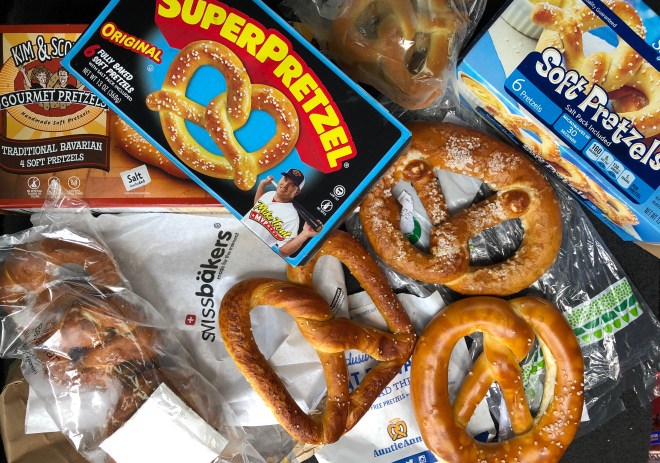
Pretzel landscape

We’re feeling good about One Mighty Mill bagels. So, this week, we moved on to pretzels. (That photo is the collection I bought from all over Massachusetts and taste-tested.)

To get started, we did some good, old-fashion market research. It’s the same kind of research we’ve been doing from the beginning — back when we were trying to figure out if our idea made sense.

At the start of the OMM journey, we had to identify the business opportunity around making “wheat you can eat”. As I’ve already referenced in this blog, we did intense research online across the entire “whole grain” category. (I literally hit over 2,000 company websites to score each and identify our opportunity to differentiate.) Meanwhile, I also started visiting my local Whole Foods and striking up conversations with team members to try and validate the customer need for products made from local, fresh milled wheat and to find out the products that sold best.

It was pretty awkward. But, not as awkward as the time when I was loitering in my local grocery store and my wife walked up behind me. She was buying food for our family. I was trying to make friends with Whole Foods employees. It was not the best husband-and-wife interaction.

Anyway, after a few weeks and about 10 visits, I was able to befriend a couple of team members. They shared lots of good information and feedback. The most valuable was some rough sales volumes for tortillas, english muffins and bagels. Those numbers are like gold when you’re trying to convince yourself that a business idea can work.

Later, to determine our bagel flavors, we did the same kind of research (i.e. a combo of awkward, first-person interactions and comprehensive industry data). So, I spent a couple of days visiting every local cafe and bagel shop. I bought a bagel and then peppered the cashier with questions about best selling flavors and customer favorites. Meanwhile, my buddy who works in private equity provided Nielsen data for the leading bagel flavors sold at grocery over the last 5 years. Turns out, Nielsen’s numbers matched what those cashiers told me. Loud and clear, they said that people love Plain bagels. Despite the fact that I never order Plain, it is far and away the best seller. The clear cut second place winner was Everything. Interestingly, there was no consistent #3. We’re using it as an opportunity to be creative and to align with consumer trends. So, we’re going spicy and developing a Double Chile & Cheddar bagel.

This week, it’s all about pretzels. We’ve decided that they need to be petite, individually wrapped snacks that are portable and designed to be eaten on the go. The individual wrapping is going to be labor intensive. But, we think it’s critical for One Mighty Mill pretzels to be conducive to dropping into a kid’s lunchbox or replacing a snack like a KIND Bar or bag of chips. So, I started with the most elementary market research tactic of all.  I googled: “pretzels near me”. Then, I spent a day tracking down every soft pretzel on the list. Like Will Farrell said in “Old School”, it was a “nice, little day” for a middle aged man to spend visiting bakeries all over greater Boston. I hit an Auntie Annie’s kiosk inside a train station, a few local bakeries, even a push cart in Faneuil Hall. Then, I went to Whole Foods, Star Market and Shaw’s to buy the rest. Last, we had to eat them to assess flavor, texture, size, packaging and everything else about the brand and product.

We’re just getting started. But, the next few weeks at One Mighty Mill will be dominated by all things pretzel.

Week #19: The logo

Logo

We love it.

But, it wasn’t easy.

Despite the seeming simplicity of that cool font and stacked name, our logo design brought weeks of anxiety, anger and joy (in that order) as we watched our company be expressed visually for the first time.

It took about 6 weeks of work with a small (but mighty) design agency in Boston. The first 3 of which brought the anxiety and anger. And since it was a visual journey with a bunch of iterations along the way, I’ve laid out a timeline with the different design versions below. Also, I’ve included the key ideas that inspired changes so you can follow how the whole process ended with joy and how we landed on a logo we love.

Weeks 1 – 2Brand v1Team One Mighty Mill wrote a Brand Brief that tried to define our value proposition, story, audience, personality, and position in the market. Next, our agency led meetings to evaluate other brand designs and create story boards. Obviously, we didn’t provide the clearest direction. Those initial renderings above tell you that we missed the mark. Those packages would be fine for just another, premium-feeling-but-generic brand in grocery stores. So, while it’s really hard to articulate feedback for look and feel, we knew that this was NOT how One Mighty Mill was supposed to look or feel. But, despite the disappointment, our design review forced us to articulate why OMM mattered and why it was different. So, in that meeting, we realized the power of simply stating where our wheat was grown and our flour was milled (i.e. “Grown in Linneus, Maine” and “Ground in Lynn, MA”). Those real places give OMM the power to truly disrupt the category, to clearly stand up and say something that matters and is real. We’d use them going forward.

Week 3Brand v2This next iteration was a step in the wrong direction. (This is when the anger and anxiety was highest.) While we added the “grown in” and “ground in” language, it still wasn’t right. I actually started to think that we may need to blow it all up and start over with new design partners and new discovery process. (I ended up being completely wrong!)
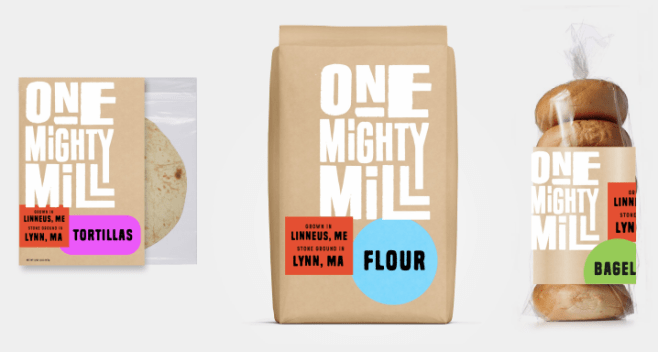
Weeks 4 – 5Brand v3We regrouped and provided really thorough feedback to our design partner. The overall message was that we needed to go more BOLD. Not bold that tries too hard. But, bold that conveys authenticity, challenges the category norm, and pops off the shelf. Be bold, fun, quirky, authentic, and friendly — a little less premium than our first 2 rounds. We gravitated towards the simpler designs in mood boards we reviewed. So, the most important directive — be bold through simplicity. As you can see in the above, we started to figure it out.

Week 6Brand FinalWe provide a final round of detailed feedback and changes. This time, we nailed it. The dream is real. In week #6 of design, there was joy at One Mighty Mill.

Week #18: Lynn, Lynn, city of sin

Lynn Google ImagesIt was crazy. When I actually stopped and thought about it, I seriously knew nothing about Lynn.
But, I definitely knew that little rhyme in the title above.

Even crazier, when I searched Google images for a photo of Lynn, Massachusetts for this blog post, the word “sin” was automatically generated as a top 5 keyword. (Check the red arrow in the image above.)

Now that I’ve visited a few times and met some people there, I won’t say the “city of sin” thing to anyone. And when I mention Lynn to others, I cringe if they respond with the saying. I don’t even like writing it as the title of this blog. I just think of how much it would piss me off if it were my city, if it were how outsiders described my community, if it were where my kids went to school… you get the point. I think a big part of why it bothers me so much is because I can’t help but relate it back to a business and how much word-of-mouth matters to a brand.

Anyway, that all-too-well-known saying is really all I knew about Lynn when I was invited for a tour by Jason. He’s the friend-of-a-friend who worked in real estate development for the Congressman who represents Lynn.

My maiden voyage actually started in Salem at Congressman Seth Moulton’s district office. Since I was still convinced that One Mighty Mill would start in Boston, I wasn’t totally sure why I was in Salem with a group of people working in state politics. Regardless, I presented a quick pitch of the business and the impact I believed One Mighty Mill could have on a community.

Everyone was excited — excited in a sincere way that I could tell was real and different. Specifically, the thing I remember most was the visceral excitement of this young guy named Marven. As I left, he pulled me aside and said something like: “If you’re seriously considering Lynn as a place for your business, then I want to show you around personally. It would be really incredible for the city.” It wasn’t so much the exact words that I remember. It was how he said them.

Afterwards, Jason and I toured Lynn and a few vacant buildings. But, my head and heart were still in Boston. So, I spent the entire next week with a real estate broker searching Boston’s neighborhoods. It was unproductive and left me feeling disappointed and frustrated. Maybe my expectations were out of line. I had just assumed that there’d be opportunities in the city’s underserved neighborhoods and that brokers and landlords would be eager to work with One Mighty Mill.

And that’s when I remembered Marven. I wanted to take him up on his offer for a tour. So, I called Jason for Marven’s cell. Literally two minutes later, Jason forwarded me the email below that he had sent to the Congressman’s entire team. It blew me away. It was proof that the need and excitement in Lynn was special.

Email Marven

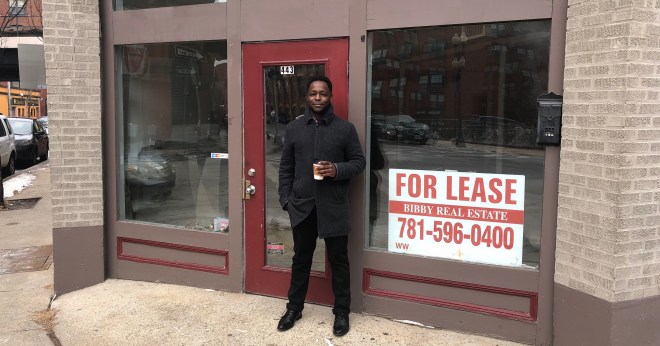
A few days later, I met Marven. (That’s him in the photo below.) Turns out, he was born and raised in Lynn, lives downtown, and nearly won a city council seat just a few month ago. We walked the streets and I looked with a fresh eye at some of the buildings I had seen on my first tour. I started to see the place and the opportunity a lot differently.

I started to get the feeling that Lynn may be the place we were meant to be.

Marven

Week #17: Location, location, location

Mill Building_River StreetNow, that’s what I’ve always thought One Mighty Mill should look like. Brick, strong, smoke stack – in my crazy head, that building symbolizes the revitalization of local food systems and communities. It’s the kind of place where we should be milling flour and making our products.
So, I was fired up when I received that picture on a text from a real estate developer with whom I had just had a conference call. It felt like he had just served up some kind of divine intervention. It’s funny – when I scheduled the call, I wasn’t sure why I was doing it. But, that’s the way my life has been since I left my company in October. I’ve been networking with everyone I’ve been introduced to or who wants to meet. The crazy thing is that most of those random meetings end up leading to valuable ideas or connections.

Anyway, it felt like some kind of spiritual awakening when I looked at my phone and saw that abandoned, old paper mill in Boston’s Hyde Park neighborhood. But, my excitement faded pretty quickly. Once I visited in person and met the developer, I understood that the building (and probably most like it) can’t be One Mighty Mill. We want to be milling and baking in 4-5 months. A building like the one in the photo is too raw, too complicated, and too big of a project to fit our timeline. Regardless, the image of that old mill is inspiring and important. Even if One Mighty Mill’s physical space can’t look exactly like that, the photo provides a visual for the feeling our location should evoke.

The building also pushed me to make our timeline a real priority and to use it as criteria for selecting location.

When I started, I instinctively wanted to build One Mighty Mill in Boston. It’s where I live, where we started our last company, and where my network is strongest. And on a deeper, personal level, I just really wanted to build something special that made a difference in my own community. Also, and I know I’m getting way ahead of myself here, I always thought that Boston – over starting it in other places in New England – provided the strongest platform for generating momentum. I thought Boston would be the biggest stage for amplifying our story and accelerating our growth.

But, I was naïve. I thought that I could just find an underserved area and build a business. Then, positive impact and goodness would emanate. That’s not how it works. After spending time in those communities and meeting with organizations and city officials, I learned it’s way more complex. While Boston has enjoyed unprecedented prosperity over the last decade, the success hasn’t been distributed everywhere. The result is that gentrification now threatens people who haven’t benefitted from the city’s growth and who grew up, live and raised families in places that used to be affordable. It’s complicated and it’s not what I expected when I started thinking about locations. Since we want One Mighty Mill to be a catalyst for revitalization, I’m concerned that Boston might be the right place but at the wrong time.

Ironically, as I wrestled with this issue, I had what I thought at the time was a “random” meeting. It turned out to be totally enlightening. My meeting was with a friend-of-a-friend named Jason. Jason was opening an ice cream shop and we were connected on the idea that my restaurant experience may be helpful.

Jason had just finished working in real estate development for Congressman Seth Moulton in the 6th district (the group of towns just north of Boston). Most of the work he led over the last 3 years was focused on revitalizing Lynn, a city 10 miles north of Boston. After explaining One Mighty Mill to him, Jason urged me to visit Lynn with him. His passion and excitement told me that there was both a serious need in the community and opportunity for a business to have meaningful impact. Jason made it clear — One Mighty Mill could make a very real difference in Lynn and could help revitalize the city. So, I eagerly accepted his offer for a personal tour of Lynn and meetings with the city officials and the Congressman’s team.

My heart is still with Boston. But, I like everything I know about Lynn so far.

Week #16: Incubate us!

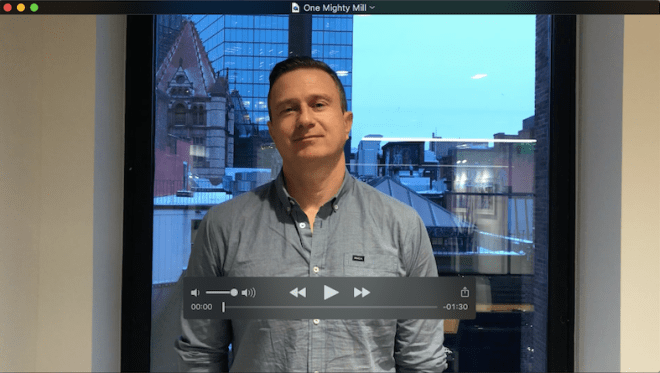
Video2As soon as I left my last company, I networked with a bunch of food entrepreneurs in Boston. That’s how I met Nico, a young star who started the awesome brand, Farmer Willie’s. His company was in the elite Chobani Incubator, a program that provides mentorship from Chobani’s executive team and a $25,000 grant to emerging food and beverage companies. Last Spring, Farmer Willie’s was one of 6 companies selected from across the country.
According to Nico, it’s an incredible program. So, I signed up for the Incubator’s newsletter. It was August and after that, I never really thought about it again until last weekend. That’s when I received an email from Chobani announcing their program’s application deadline on January 30th – only 4 days away.

I knew the applicant pool would have hundreds, maybe even thousands, of companies that we more mature than One Mighty Mill. But, I thought we might have an outside shot based on the power of our concept and vision for impact. I figured we had nothing to lose except the time it would take to complete the application. And even then, I felt like there was value in going through the application process regardless of the outcome.

So, yesterday, this 42-year-old crammed like a 22-year-old college student and submitted the online application literally 2 minutes before the 11:59pm deadline.

I know it’s a total long shot that we’ll be selected. (We haven’t actually launched our company!) But, as expected, the exercise turned out to be very worthwhile. The essays were rigorous and forced me to refine our point of view and strategy. And more importantly, the application required a 90 second identity video where I had to stand in front of my iPhone and answer 2 questions: 1) What was the inspiration to launch your company and 2) What makes your company special.

When presenting One Mighty Mill to somebody new, I find myself needing at least 5 minutes (sometimes, I can preach even longer if I’m feeling especially fired up). So, forcing me to articulate our story in 90 seconds was really valuable. But, it was not valuable for my wife, Mel. She was the innocent victim who had to record my pitch. After 10 shoots in our living room, I begged her to record a few more attempts, followed her to her office, and hijacked a conference room. It got worse. After a few more shoots, Mel refused to do any more. So, I asked one of her colleagues whom I’d never met to take a couple more.

After what must have been 25 attempts, I made this video that I submitted to Chobani. I’m hoping it captures the spirit of One Mighty Mill in 90 seconds.

Week #15: Our wheat gets around

QuincyRight now, the quest to restore local food systems doesn’t feel all that “local”. In fact, I’m pretty certain we have to be the most inefficient bagel-tortilla-pretzel makers in the industry. But, you know the saying: if it were easy, everyone would do it.
So, we’re definitely doing something that nobody else is doing (i.e. traveling all over New England to make flour). And there’s a good reason for it. You have to be crazy, unemployed, irrationally curious about local wheat, and have a valid driver’s license. (I just checked Google maps to confirm we brought our grain over 775 miles in order to test our flour in products.)

That long and windy road starts in northern Maine, stops in Quincy, MA, does a U-turn to Vermont and then back to Boston.

So, this is how it works:

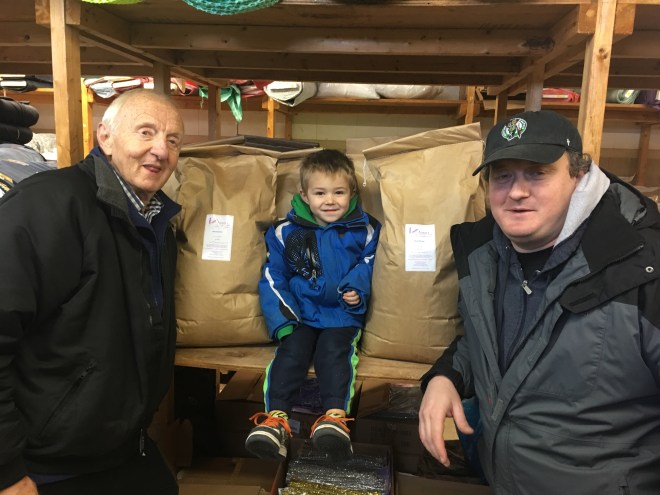
A week ago, we received our first pallet of wheat from farmers, Sara and Matt. Actually, my dad, son, and brother (that’s them in the photo above) received it. Right now, One Mighty Mill is pretty much only mighty in heart. We don’t have a mill or a place to store wheat. So, I had the pallet shipped to my parent’s warehouse in Quincy. My mom, dad and brother own 3 fabric stores in and around Boston and have a warehouse full of fabric, ribbon, thread… and now wheatberries.

Jon and Andrew

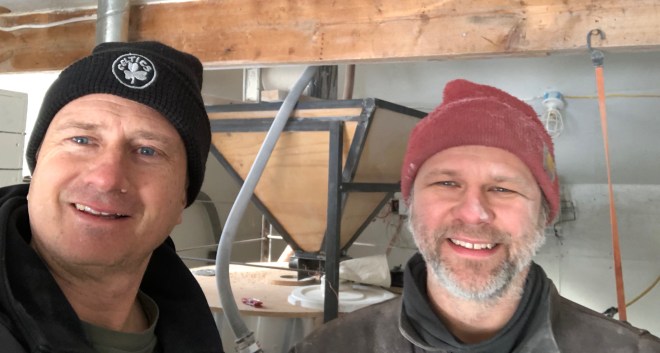
Next, to turn that grain into flour, I drove to visit Andrew in Wolcott, Vermont. (That’s us in the photo above.) While building our mill, Andrew has been grinding our wheat for us. That way, we can test recipes with real, stone-ground flour.

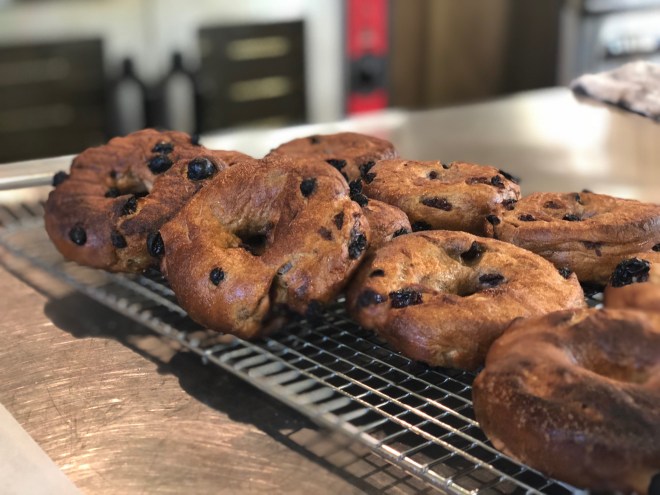
Thankfully, the flour making odysseys are nearly over. Andrew just confirmed that our mill will be ready in a month. And while the travel may seem crazy, I know it’s been worth it when we get to see and eat the finished product. A couple of days ago, we baked our first round of cinnamon-raisin (below) and jalapeno-cheddar bagels. They tasted like food that somebody put thought, time, and care into preparing. If our customers taste that love, then there’s no doubt that One Mighty Mill is bound for glory.Cinnamon Raisin

Week #14: Ring the bell, school is in

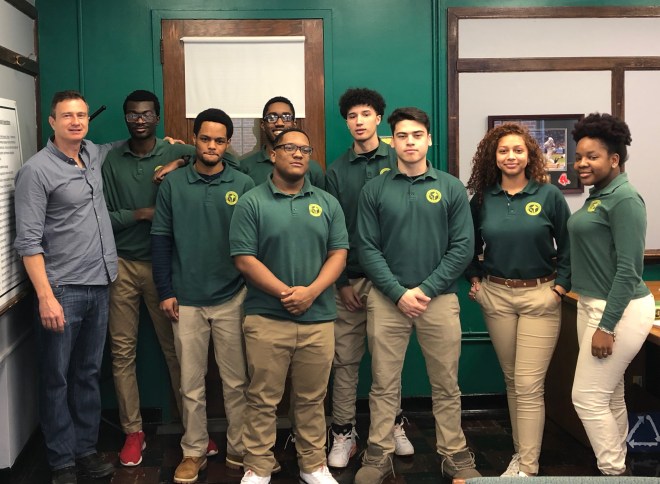
class picFor the last 7 years, I’ve had a close connection with a school in my neighborhood, Cathedral High School. It’s a philanthropy-based school for boys and girls from underserved communities in Boston. Every Sunday morning in the winter, I’ve run a youth basketball clinic that raises money to fund scholarships there.

So, it’s a special place for me. And over the years, I’ve become friends with the Head of School and the Athletic Director and Basketball Coach. (My oldest son is even the team’s ball boy.)

This fall, when the Head of School knew I was transitioning from my company, he encouraged me to teach a class on entrepreneurship. He has an innovative and inspiring vision for the school. It’s based on the concept of developing students into leaders in the new economy by teaching kids experientially, or through “applied learning”.

It’s a vision to help kids that you just can’t help but believe in and want to contribute to. So, just before Thanksgiving, I committed to teaching a class.

And since today was the first day, I’m no longer just an aspiring miller and bagel-pretzel-tortilla maker. I’m a teacher, too.

I’m teaching a one-hour class every Friday for the next 5 months. Most importantly, I’m committed to making my kids part of this real-life, real-time journey to build One Mighty Mill. If I pull it off, it’ll be a truly unique experience for the kids to learn and build alongside someone who is actually starting a business (and someone who has done it before). If I’m an effective teacher, I’ll make them feel like they’re partners in the creation of a business and consumer brand.

I designed the curriculum to be aligned with the work we’ve done so far to start One Mighty Mill and the work we’ll do over the coming months. So, it includes things like competitive analysis, brand design, product R&D, business plan development, fundraising, and real estate selection. For the course materials, I’m using the actual documents we’ve created and will develop. Those documents will be brought to life with visits from our chef, designer, lawyer, and architect. And to make sure it’s truly experiential learning, we’ll also get outside the classroom. We’ll visit Whole Foods to research competitors and meet with a store manager. To close it out big, our end of semester project is a retail pop-up event to actually have the kids market and sell our products. The plan is to partner with a local restaurant and sell One Mighty Mill bagels during a morning breakfast event in May.

For homework, I want assignments to be more attuned to the digitized, modern business and to reinforce creation, risk-taking, and accountability. So, I’m making  every student keep an online blog. (Clearly, I was inspired by this one.) Every week, their deliverables are posts with their own commentary on an assigned topic. Then, every student is required to post a photo with the link to their blog entry on their own instagram pages. The goal is to learn by acting like an entrepreneur. It’s about having your own, original point of view and the courage to express your thoughts in writing and to share them with the world.

Anyway, today was my first class and we started strong.

I set the tone early by naming the course, “A Real Intro to Entrepreneurship: Rebellion, Innovation & Idealism” and by pumping a Rage Against The Machine song when they walked in.