Week #3: I know what I don’t know

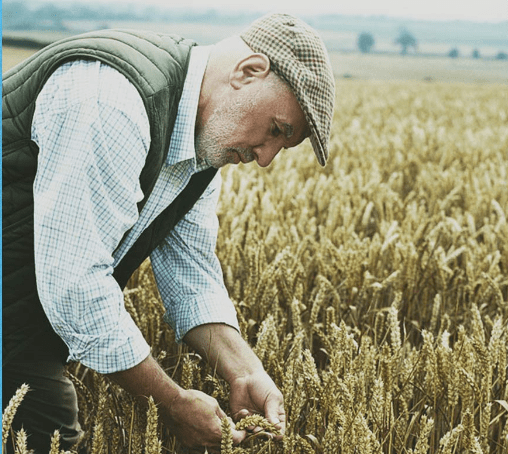
hand pick wheat

I don’t know anything about grain, especially wheat.

And based on the strange responses and looks I’ve been getting from the people I know, I’m pretty sure that nobody else knows anything either.

I don’t know how grain is grown, where it’s grown, or even what it really tastes like. But, I’ve spent the last few weeks learning a really compelling story. It’s the story of the elimination of a local food system and the inevitable damage that’s caused when we mess with the natural order of things and industrialize our food.

To understand the problem, you need to know how it used to be.

Before the industrial revolution, Americans grew, stored, milled, and ate locally grown and milled grains. Farmers brought their dried wheat harvest to the town miller. There, all three of wheat’s main components were ground together: the fiber-rich bran, the nutrient-dense germ, and the starchy endosperm. It was fresh (i.e. perishable). Back then, flour was a complete food that nourished people, farmers, and local food economies.

But, all that changed with the invention of the roller mill — the machine that made shelf stable white flour. Wheat became empty. Empty in flavor, nutrition, and soul. Flour went from being a living, perishable product to a stable, cheap commodity. Everything consolidated. Those local, sustainable networks of farmers, millers, and bakers vanished. Local mills closed and local family farms stopped growing grains. They were replaced by a handful of giant, industrial monoliths in the mid-West. As a result, wheat and flour became a commodity without a sense of place or connection to a community.

Because of the low cost and indefinite shelf-life of refined grain, we (i.e. Americans) started making and eating a ton of it. And for the last century, it’s been slowly and invisibly killing us in the form of diet related conditions like obesity, diabetes, and heart disease. When you remove the fiber and nutrients, flour becomes basically just starch that your body converts to sugar. And too much sugar causes big problems.

We’re left with this huge contradiction in our food culture. We’re obsessed with health and sustainability. But, since we’re completely detached from grains and mills, we ignore the biggest opportunity to improve what we eat and what it does to our health, environment, and community.

So, my history lesson clearly tells me that the idea of reviving local wheat presents a real opportunity to do something important. And as a business opportunity, it’s exciting because of the comparable success of other commodities that became “craft”. It may be hard to remember, but coffee, beer, and chocolate were all once commoditized ingredients (think Folgers Crystals, Miller Lite, and Hershey’s). Before Starbucks and Sam Adams, they were foods and drinks that had no stories of craftsmanship, no sense of place or origin, and no higher purpose.

There’s no “craft” in wheat and it sure feels like it has to happen.

But, it’s also about more than being the next “craft” food trend. Wheat, when grown and processed properly and with integrity, can change the health of our country. So, we can’t let it be an empty commodity. We can’t keep eating it as oblivious, passive consumers in a broken food system. We need to fix this.
Week 2: Local buns, where you from?

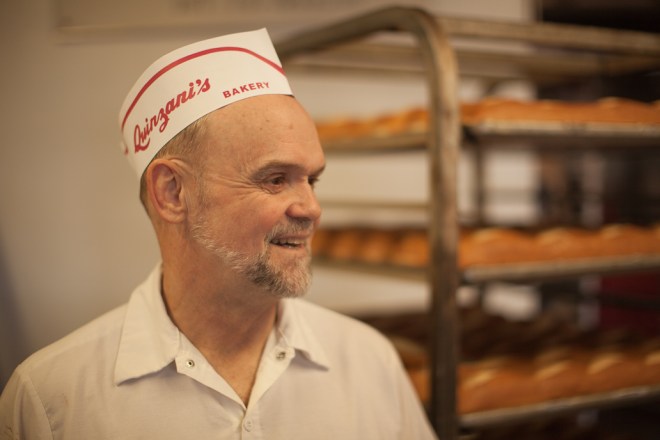
Quinzanis 27Quinzani’s Bakery was a 3rd generation bakery in Boston’s South End that was in business for nearly 100 years. It was just a few blocks from our first restaurant. So, from the day we started in 2004, we were proud to buy all our whole wheat burger buns from the three brothers who ran the bakery. And as our business grew across the Northeast, we really liked serving those buns until Quinzani’s closed down a decade later.
Quinzani’s always epitomized “local” food for me. It was a small, family run business. I personally visited the bakery almost every week. I was friends with the brothers who owned and worked in the bakery every day. On top of that, I actually lived around the corner.

But, by the time they closed in 2015, I had begun to wonder about the concept of “local” bread. More specifically, I wondered if it were even possible to serve “local” burger buns that complied with our own vision of “farm-to-table”. Like our veggies, beef, and cheese, could we actually know the people and places growing the ingredients in our buns? Could we have a connection to the people who grew those grains like we did with RobRoy, Steve, and Larry Quinzani?

Early on and before most of our competitors, we learned that connecting consumers to the people who grew and made their food resulted in better food, more loyal customers, more invested employees, and a stronger brand. So, I spent over a decade working to build a restaurant business that made local sourcing a cornerstone in its mission to make “real” food. I visited farms, bakeries, dairies, and even a slaughterhouse (I’ll never do that one again). I communicated the stories of our supply chain to our customers and promoted the importance of local to our teams in the restaurants. And I didn’t stop at just visiting farms, I pushed to start growing our own veggies; to be even more committed to “farm-to-table” by owning a piece of our supply chain. We grew tomatoes on rooftops of our restaurants, teamed up with a local farmer to grow kale hydroponically in a shipping container, and even operated our own farm that was on an island in Boston Harbor.

And it worked. We built a thriving “farm-to-table” restaurant brand. But, that’s exactly the reason why I was thrown for a loop when I started wondering where those Quinzani buns were really “from”. We were supposed to be experts. But, somehow, we never considered that there were farms beyond that local bakery. Even more, I had never seen, touched or tasted wheat before in my life. And until Quinzani’s closed, I had never even thought about it.

So, when I left my company, I knew where I wanted to start — grain. My ignorance on the subject, intuition, and the memory of my beloved, local bakery are all telling me that there’s a systemic problem here. I’m feeling pretty certain that, just like all industrialized foods, it’s a problem that’s hurting the health of communities, its farmers, and consumers.

Day 1 of my new life

It’s October 18, 2017. The first day of my next thing. And the first day writing this blog that I’ve promised myself I’d update every week to document my journey.

Three months ago, I officially left the company that my best friend and I started 14 years ago. Since the restaurant business is all-consuming, my life, identity and heart (and those of my wife and 3 boys) were inextricably linked with the company.

Anyway, as a part of the transition, I stayed on as a “consultant” for 90 days. And today, that gig is up.

Today, I start again. But at 41 years old, I’m starting with a different worldview than I had at 27. This time, I understand what matters most to me in the next company I help create, the culture our team builds, and the impact we have on our community. I’m acutely aware of legacy and inspired by the need to put forth goodness into the world. So, I’m starting on “Day 1” by writing a couple of the important things I learned from my last entrepreneurial journey. I know they’ll be fundamental to what’s next.

First, while I felt the full gamut of emotions through the process of leaving (from depression to liberation), the most profound one was raw, overwhelming gratitude. The act of saying goodbye personally to hundreds of people who contributed parts of their life to something you started is completely humbling. And the memory of that feeling is indelible in me. I always thought that I appreciated the success of our business. But, leaving made me feel gratitude in a way that I never would if I had stayed. Leaving granted me new perspective to become a more empathetic and effective manager and leader. But mostly, leaving showed me that at the end, it’s the people and the relationships that are all we are left with and all that matter.

Second, when we started our restaurant business, I was inspired by the belief that we could change an industry ridden with chains serving industrialized food. (It’s hard to remember, but 14 years ago, our food landscape looked completely different.) I was inspired by the belief that we were bringing healthy food to a world that didn’t have it. But, as our company scaled, that landscape changed. Healthy food was popping up all around us. And while that’s a great thing, I started to realize that it wasn’t necessarily a great thing for everybody. I understood that just like our food landscape, the ways to have impact changed, too. Making a difference meant resisting the system that provides healthy food based on the neighborhood you grow up in or the kind of job you have. So, I know that I want to do work that helps make sure healthy food is for everyone.

I’m starting Day 1 with these reflections. It’s a little intimidating to think about how much there is to do to ever create a company with the success of the last one. But, I know for sure that if I hold on to these lessons, I’ll have everything when I’m done.