Week #13: We’re cooking

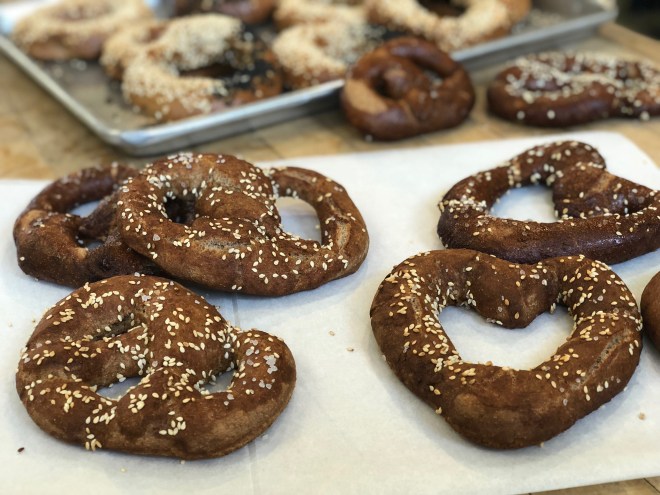
Bagels Round 1This weekend, we made these.

We got wheat berries grown in Maine, ground them on a stone mill in Vermont, rolled the flour out by hand into bagels, and boiled and baked them in Boston. (We just rented commercial kitchen space where we’ll be baking every Wednesday and Saturday morning through the spring.)

We screwed up a bunch of times. (Personally, I have no idea what I’m doing. I basically just wait for instruction and try my best not to form everything I touch into weird shapes). We worked pretty inefficiently. It took 4 hours to make 12 bagels and 12 pretzels.pretzels round1But, it was a big step.
So far, I’ve blogged about everything except our products. Before explaining how we selected them, I need to clarify. Our big idea is making “wheat you can eat”. So, the dream is that One Mighty Mill will be a food brand with a diverse portfolio of products sold at grocery stores. Our flour is the foundation of it all. It’s the critical ingredient that’ll enable the fulfillment of our purpose – to make wheat you can eat by restoring a healthy, local food system. But, we’re not out to sell flour or bake mixes. We want to create a powerful consumer brand that inspires people. And no matter how much value stone milling and local sourcing adds, flour will always be converted into foods made by its customers. That dilutes the connection. So, we want to create that moment of happiness when somebody eats a product that we create by milling local wheat and baking it into something delicious.

Our plan is to launch One Mighty Mill with 3 products: bagels, tortillas (or wraps) and pretzels. We validated the opportunity for each by conducting deep analysis of the “whole grain” products currently sold at America’s grocery stores.

We learned that there are 7,000 “whole grain” products across 18 categories. And in all but a few, there’s serious competition. So, in cereals, sandwich breads, and crackers, it’d be difficult to win consumer attention and grocer shelf space. (It’s crazy – there are more 1,200 cereals alone classified as “whole-grain”!) But, there are hardly any brands competing in the bagel, tortilla (or wrap), and pretzel categories. (In contrast to cereal, there are only 11 pretzel, 23 wrap and 27 bagel brands.) Even more, they haven’t innovated. No bagel, pretzel or tortilla brand conveys their value through nutrition, farm-to-table sourcing, or fresh milling.

As icing on the cake, the 3 products also all have rich history in our food culture. Since restoring local food systems includes reviving and honoring food traditions, products with authentic heritage (i.e. products like bagels, pretzels, and tortillas) strengthen our concept and brand.

Anyway, that’s how we ended up baking those beautiful bagels and pretzels this week for the first time.

We’ll do it again every Wednesday and Saturday morning from here out.
Week #12: The name!

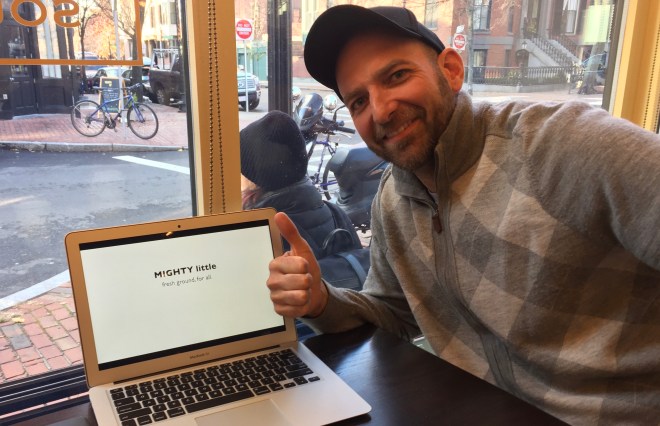
Chris Mighty LittleThat’s Chris. He started a big digital marketing agency in Boston. We met a few years ago when his firm designed a mobile app for my last company.
Even though he only oversaw my project at a high level and participated in a few meetings, I knew Chris was different. Up until then, I always felt like the creative people that we worked with never really got it. Chris had an intuitive understanding of what our brand stood for and how we should communicate it. And more important, he was honest and real — he was all about doing good work that stood for something.

Anyway, earlier this summer, I heard that Chris was selling his agency. I took it as a sign. So, I waited for a good time to reconnect and pitch him the idea for this new business. We met up about a month ago. He left fired up to help create a food brand with a big dream to change the game.

And since we’re under a self-imposed 1-week deadline to name the business and brand, we needed Chris’ help this week.

So, I took that photo above a couple of days ago. Chris is smiling with his thumb up because we thought we had it.

Mighty Little.

I loved the name. It was totally different from anything on our list. But, it was an original way of expressing the strength and spirit required to bring goodness back to a broken food system. Meanwhile, the “little” let us stay humble, not preachy. It was all about a simple idea and a small, inspired resistance against Big Food.

I bought the domain and registered the instagram and facebook handles and started dreaming of signs, packaging and t-shirts.

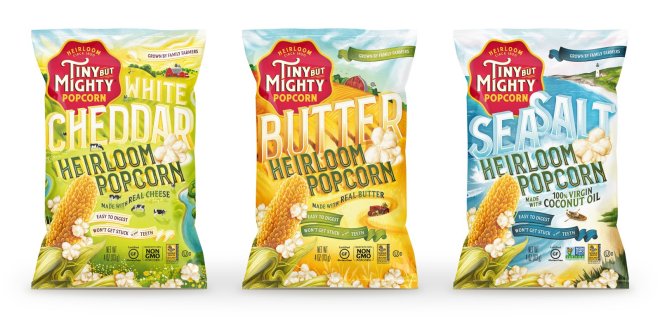
But, the next day, those dreams were crushed by a small popcorn company in Iowa named “Tiny But Mighty”. It was a setback. But, it was also a breakthrough. We realized that we loved the word “mighty” for expressing who we want to be. It captures our mission to strengthen bodies, farms, and neighborhoods by reviving local food systems.

Tiny But MightySo, after more deliberating, we came up with these 2 finalists:
  • Mighty For The Many
  • One Mighty Mill

I preferred Mighty For The Many. Another co-founder voted adamantly for One Mighty Mill. Chris liked both.

So, like I do with every important decision, I brought it to Mel. She’s my wife, consiglieri, and the person who somehow makes me less crazy and just plain better with her incredible combination of irrational support and practical wisdom. (For the last 21 years, we’ve been locked in together in every adventure – business and life.)

After considering both names for a few days, Mel texted me her conclusion that Mighty For The Many could be preachy and confusing – the two things I most wanted to avoid. She also reminded me that modesty is an endearing quality of the people building our company. She voted for One Mighty Mill and even added that she now loved the name.

That was all I needed. I moved on from Mighty For The Many. The team settled on the name that has clarity and power.

It’s official. We are One Mighty Mill.

Let’s go!

Week #11: Give it a name

Name notesThis needs a name. This really needs a name.
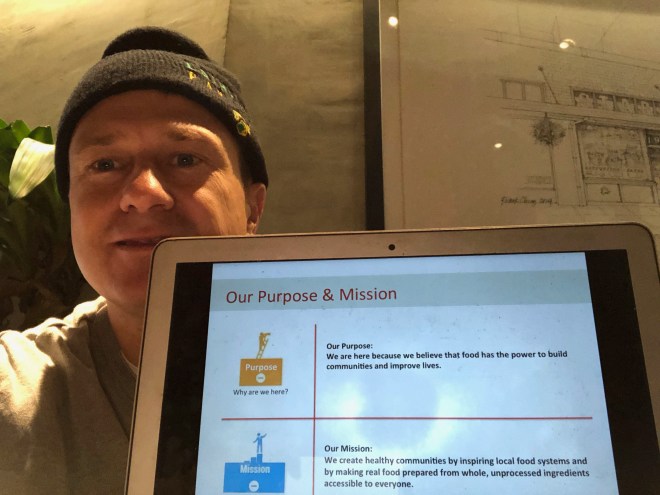
From the moment I started this blog, I’ve kept a running list of random names for the business. Just about every single one is bad.

I’ve found myself looking for inspiration everywhere – in old, obscure writings about wheat and mills, on technical, agricultural websites that identify the varieties of heritage wheat, in lyrics to songs, on social media posts of people and brands I think have original points of view, in the random conversations of people around me.

It’s insane behavior. But, it’s pretty much how my brain has been functioning for large parts of the day.

When inspiration does strike and a name or a conceptual idea hits, I panic. I stop whatever I’m doing and write it down immediately in my notebook or in the notes app on my phone. It’s happened while jogging, driving, lying in bed, and in the middle of conversations.

Now that we have our mission statement, there’s a framework for identifying what’s right. But, it doesn’t give you the idea for what you should be called. It’s really hard. The name has to symbolize the wholesome, delicious real food we’ll make and the healthy, local food system we’ll revive. It has to imply goodness and impact. But, it has to do it by being subtle, unassuming, and honest. The name and identity can’t come off too preachy. We can’t seem boastful about our purpose or even worse, phony.

Right now, not having a name is causing two problems. The first is a personal thing. It just feels a little empty without an identity. It won’t be 100% real until I can visualize what our customers will see. The second problem is that it’s preventing me from signing an agreement with a designer. Over the last month, I’ve gotten help from friends who are senior execs in marketing. They helped me evaluate and then, select a great design partner. They also advised me not to sign a contract and start the creative work until the name is selected. That way, the designer has clear direction and we have the best chance to authentically express the name and brand through the visual identity, logo, and packaging.

So, I’m setting a deadline. We’ve narrowed the huge list of names in my notebook down to 5 and giving it a week.

If creative brilliance doesn’t strike in 7 days, then we’re going with one of these and signing the agreement with our designer:

Name: Arthur’s Artisan

Relevance / Symbolic Connection:  Named for grandfather. Personal story rooted in heritage, honor, and resiliency.

Name: Banner

Relevance / Symbolic Connection: Heritage winter wheat variety brought to Maine in 1837. Before its arrival, the state was dependent on importing its grain. By late 1800s, Banner wheat was grown with abundance and all the flour used in the state was grown locally.

Name: Furrows & Lands

Relevance / Symbolic Connection: The surface of a millstone is divided by deep grooves called furrows and separate flat areas called lands.

Name: Kernel

Relevance / Symbolic Connection: Often called the wheat berry, the kernel is the seed that is milled to make flour and the seed from which the wheat plant grows.

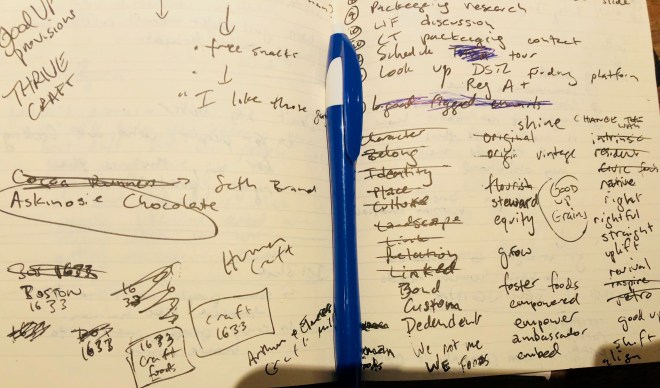
Name: 1634 Craft Foods

Relevance / Symbolic Connection: First water powered grain mill in the United States was in Dorchester (neighborhood of Boston) in 1634

Week #10: “We’re on a mission, you better just listen”

MissionSince this will be my second crack at building a company, I know there’s something we need to do in order to have the chance to build a great, authentic brand, instill a culture that inspires team members and customers, and be an effective leader.
That all-important thing is establishing our purpose, mission, and values right now, at the very start.

So, before moving forward with a name, brand, or formal business plan, I’m documenting the founding purpose and drafting the mission and values. I’m writing them out so they’re concrete and lasting. Then, we’ll use the mission and values for everything we do from here out – from naming the business to developing the products to selecting the real estate location. If everything we do extends from the mission and values, then we’ll have built something truly worthwhile.

Writing mission statements is painful. It feels soft, fluffy, and lots of times, like an exercise in building consensus around corporate jargon. I know because I led the process in my last company. And looking back, I know for sure that we were too late on it. From the start, we always led with entrepreneurial passion that was contagious and we treated people like family. Those things were powerful enough to build a special culture. But, I suspect we were like many other founder-led, entrepreneurial companies in that we never forced ourselves to articulate those values and our higher purpose in a tangible way. As a result, we could never systematize them into our business and culture. And as we grew, I think our — and more specifically, my own — lack of discipline around our mission ended up diluting our culture.

This time, I get to do it over. So, I’m going to do my best to get it right. I have the advantage of experience and a great resource shared by a Board member at my last company. In his book, The Servant Leader, James Autry provides a blueprint for expressing an organization’s purpose, mission and values by answering three pretty simple questions.

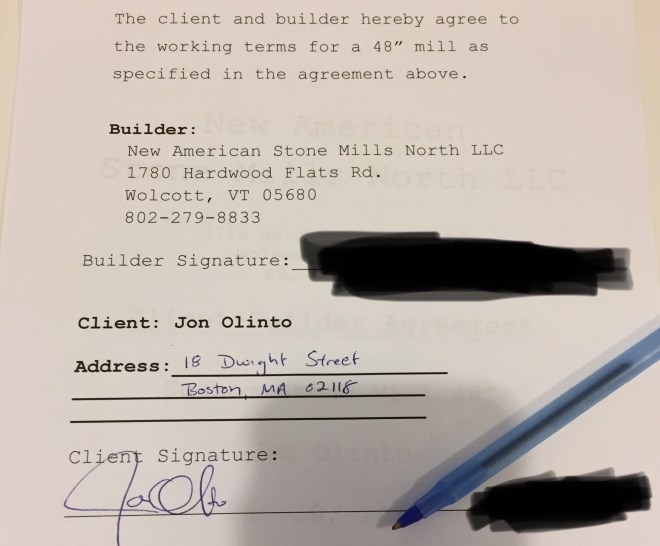
This week, I forced myself to re-read that book and then, spend a full day answering those three questions. Here’s what I came up with:

OUR PURPOSE (i.e. Why are we here?)

We are here because we believe that food has the power to build communities and improve lives.

MISSION (i.e. What do we do in order to fulfill that purpose?)

We create healthy communities by inspiring local food systems and by making real food prepared from whole, unprocessed ingredients accessible to everyone.

OUR VALUES (i.e. How do we behave as we perform our mission and fulfill our purpose?)

We live by these 5 core values that define our culture and business philosophy, drive our decisions, and serve as a compass for our future journey:

  1. Nourish bodies and communities

Healthy is balanced goodness and shared value. We nourish by serving real food and by improving the lives of all the people in our food system – our farmers, team members, customers and neighbors.

  1. Be real

Real means transparent and unpretentious. We make honest food that honors tradition and heritage and we build genuine relationships with all partners.

  1. Stay on the grind

Passion and determination determine our life-or-death. Inspiring change in our food system takes more than just hard work. It requires never, ever giving up.

  1. Cultivate a team that’s family

It’s about we not me. We give of ourselves so that others can grow. And we believe in each other and in our shared work to create meaningful change.

  1. Leave a legacy

Do work that matters and that we’re proud of. Remember that when it’s over, the relationships we have and the goodness we’ve put forth is all we’ll be left with and all that matters.

Week #9: It’s official. We bought a mill.

mill contractThe check is cut. So, we bought a mill. Well, we kind of bought a mill. What we definitely did do is sign an agreement to buy one and send a check for the deposit.
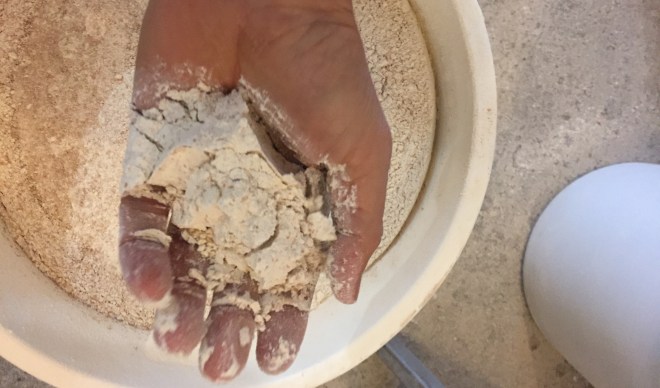
Suddenly, this whole thing is more than just a blog and PowerPoint deck. ($25,000 has the power to make something very real, very quickly.)

When I started this blog, I was also doing some hard core research. I read analyst reports and consumer studies and visited thousands of food and beverage websites. I even built a huge spreadsheet to assess the competition by scoring food companies against my own grading system. (It was almost 3,000 brands and 8,000 products.) Then, I distilled that research into 20 PowerPoint slides that present a clear opportunity to develop a differentiated brand and business.

What I discovered is that nobody in the whole-grain industry is using fresh milling and farm-to-table to convey their value. They can’t. They’re all captive to the same industrial supply chain. Meanwhile, in the larger Food & Beverage space, it feels like most have the same tone, visual aesthetic, and social mission strategy. It’s like there’s a template for creating the brands. So, I think we can create real differentiation and disruption by breaking the mold: enter a commoditized, un-trendy category; have a purpose and story that’s bigger than healthy food and an inspired founder; own the craft of actually making the products and creating the supply chain; and last, design the business to stand for systemic change instead of adopting somebody else’s cause.

Lately, I’ve been validating the opportunity by pitching my PowerPoint to smart people who know food, business, and brands. So far, so good. Everyone agrees that there’s something potentially big here.

But, until I signed the agreement for the mill and cut the check, there was never anything tangible. (It doesn’t get more tangible than a huge machine that spins 48” stones that weigh more than a car.)

I’m blocking out the very stressful reality that we bought a mill without a place to put it. (Unless, I want to move a big grain mill into my 2 bedroom apartment with my wife, 3 kids, and dog.)

In 10 weeks it’ll be our’s.

Week #8: Miller time

FlourA few months ago, there’s no way I’d have ever believed that I could be so happy about sticking my hand in a bucket of flour. And I’d never have believed that I’d be happy about driving to the far corners of New England to pick up wheat berries in Maine and mill them in Vermont.
So, that’s my hand full of flour that was just ground fresh on a stone mill. And that means I’m holding the very essence of the food we want to make and the company we want to build.

This flour is special. It’s fresh, real food that needs to be refrigerated instead of sitting on a grocery store shelf or in a kitchen pantry for months or years. It’s perishable food that should be consumed as soon as possible to ensure its nutritional value isn’t diluted.

It looks different – light brown and less powdery than I expected. It smells different – I have no idea what to say it smells like except that it’s a pleasant, earthy odor. (The flour you buy at grocery stores is completely odorless.) And it feels different – moist, a little warm from the friction of the stones, and gritty with little flecks of bran sprinkled throughout the finer particles.

This flour is also special because of how hard it was to get. In stories I’ve already told in this blog, I had to find some of the only organic wheat farmers in New England, convince them I was for real, and head back up to get a sample of the wheat. Then, I essentially had to do the same thing all over again (plus, stare down a dog) to work with the miller.

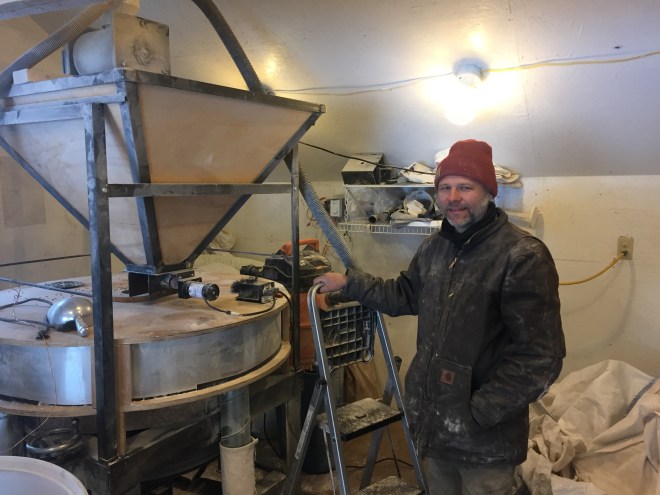
So, when I stuck my hand in that flour, I was at Andrew’s mill and bakery in Vermont. He had agreed to grind 50 pounds of wheat for me. It took about 45 minutes and was way easier than I imagined. Basically, Andrew just poured the kernels into the funnel at the top of the machine. A few minutes later, flour flowed out of a sleeve at the bottom.

Andrew at mill

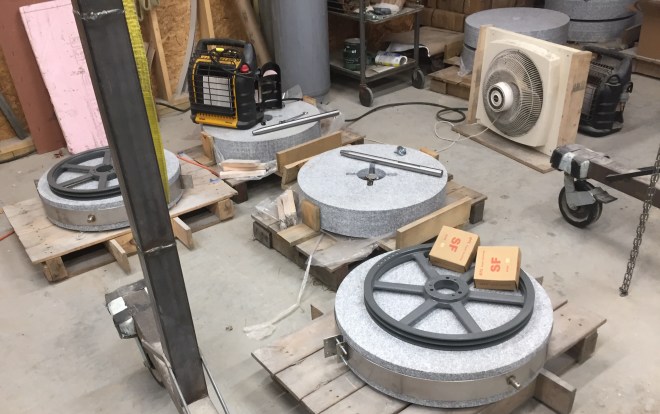
While the mill was running, I learned the basics of operating the machine. I also learned that Andrew’s mills are more than just pieces of equipment. They are an expression of his values. He bakes bread with Vermont wheat that he grinds himself and he builds mills with steel fabricated by a nearby metalworker and stones from a quarry close to his bakery. Then, he has those granite slabs shaped into wheels by a Vermont craftsman who makes gravestones.

As we hung out in his workshop with a bunch of granite wheels on the floor, I could envision a tipping point for local mills and grain. When I asked Andrew about the stones, he informed me that he is building mills for a few other bakeries. He also told me that he wasn’t following up with inbound requests because there were just too many.

Stones

Andrew went on to tell me that he had just built his largest mill for Whole Foods. I was blown away. The grocery giant wanted a working display at their new flagship location in Atlanta. While Andrew was concerned that big company bureaucracy may kill the project, it was irrelevant to me if Whole Foods ever used the mill. The fact that they wanted it was total validation that we’re on the verge of a critical shift in our food system. Standing there, I felt certain that I’ve stumbled upon an incredible opportunity to create a business that can help propel that shift.

Right then, I knew there two two urgent things to do. First, turn Andrew’s fresh flour into products that we could taste. Second, sign a contract with Andrew to get started. The next mill he builds needs to be our’s.

Week #7: How I got 45 minutes with Deval Patrick

DevalI play old-man basketball every Thursday night. After hoops, we hit a local pub for post-game beer and camaraderie. Among the over-the-hill ballers is Oscar, Head of School for an urban high school in Boston that serves inner-city kids. This Thursday, I was discussing my business concept with Oscar. Given his work as an educator and advocate for underserved kids and families, I wanted his thoughts on making a real impact.
I’m inspired by the knowledge that making food from fresh milled wheat improves people’s health. I’m also inspired by the fact that a revival of a local wheat economy has game-changing financial and ecological benefits for small, family farmers. But, I think a business can do and be even more.

The existing model for most consumer food brands makes good business sense. Local, craft food companies are designed for affluent consumer segments. But, if we’re going to make healthy food more accessible, value needs to spread beyond those businesses and consumers. While I’m not sure on the structure, I’m interested in a new model that could win financially through sales at grocery stores and simultaneously improve a distressed neighborhood. Right now, I’m thinking that I want to operate my business in a “food desert”. But, I’m aware that as good as my intentions may seem, opening a business the wrong way could actually hurt people I’m hoping to benefit. Gentrification is complicated and it’s left me struggling with the question of how I can strengthen a neighborhood without threatening people who live there.

There was a lot swirling in my head as I questioned Oscar.

“You should bring this to Deval!”

Oscar knew that I had crossed paths with Deval Patrick during my run with my last company. (I met with Deval last Spring and even had his cell.)

It was midnight at a bar, I had just played basketball for 2 hours, and I had a couple of beers in the tank. I thought it was brilliant. But, things that seem brilliant at midnight in bars usually don’t seem that way the next morning. So, when I woke up, I felt unsure about the idea of contacting the former Governor of Massachusetts and the guy who recently has been urged by Obama’s inner-circle to run for president in 2020.

By the time I wrote my to-do list, it seemed like a pretty stupid idea. Regardless, I wrote “Contact Deval Patrick” just above the other random tasks I had for my day.

But, here’s the thing – I’m at a point now where I’ve pretty much freed myself from the fear of risk and the concern of what people think. That’s not to say I’m in some transcendent state of zen. Not even close.  I have plenty of feelings of anxiety and self-doubt. And some nights, I don’t sleep that great. But, it’s mostly from the structure that’s missing when you don’t have a job and even more, when you’re no longer running a company. It’s structure created by meetings, emails, calls, and deliverables. So, sometimes I feel a sense of awkwardness from not having those on a daily basis and from not having a team to lead or customers to serve. But, I’m aware of an important truth: not having to be a part of the structure means I’ve been given an incredible opportunity to be free, creative, and to embrace the feeling of having nothing to lose. So, it’s not that hard to remind myself that I’m not supposed to act “normal”. I’m just supposed to do whatever I think gives me the best chance of making the best company I can. If I don’t, then I’m wasting the gift of freedom.

So, that’s why — even though I had no business doing it —  I picked up my phone and texted Deval Patrick.

And you know what? He texted back. He texted back in like 2 minutes.

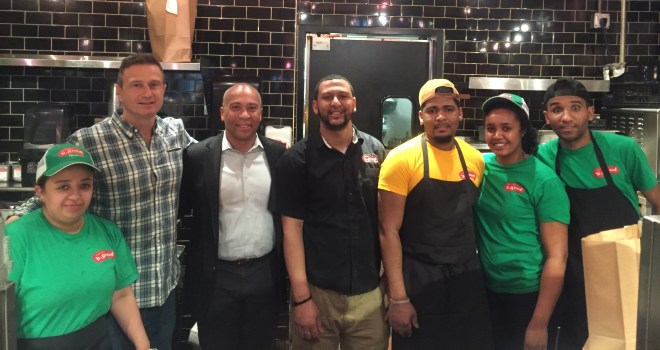
6 hours later we were sitting in his office talking about mills, wheat, and shared value.

He is incredible and probably the most impressive person I’ve ever met. I was so lucky to sit with him, share my vision, and get his insight for designing impact into the DNA of a business model.

But, there’s something else I’ll remember just as much from the whole experience. It’s that moment when I looked at my notebook and thought “F – it” and texted Deval Patrick.

Week #6: My first local wheat berries

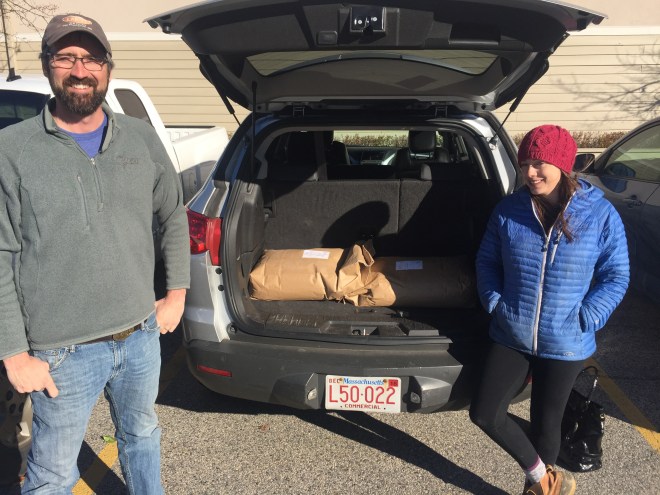
Sara and MarcusGetting those brown bags in the back of my car was a really big moment.
On Friday, the Williams, the farmers who I visited in Northern Maine, met me in Portland with 100 pounds of their wheat. That’s Sara and her husband, Marcus, in the photo. They were down from Aroostock County to attend a wedding. So, instead of shipping all that grain, we agreed to make the exchange in-person.

When visiting their farm a couple of weeks ago, I learned they had 100,000 pounds of wheat in storage. I also learned that if stored at the proper temperature and aridity, dried wheat can be held for years. It becomes perishable when you mill it the old-fashioned and the right way: break the seed, expose the germ, and retain both the germ and bran in the flour. (The modern, industrial way removes them and renders white flour as dead starch with unlimited shelf life.)

For a couple of reasons, understanding wheat storage was an important revelation. I didn’t know it could be stored. And I definitely didn’t think that the Williams had that kind of inventory. While I don’t know how much wheat is available in New England, my gut and my basic research tells me that their 100,000 pounds is a major share.

So, getting a sample of that wheat in storage was important. It represented the first step towards the pivotal decision that could make this whole thing real. If I’m going to build a food brand around local wheat, I need to seriously consider writing a check soon. Sara suggested that it can work. She’ll sell me all the wheat in storage, hold it for me while I get my business plan ready, and then, ship down pallets of it as needed. But, she needs a commitment (i.e. a deposit of $25K) by the end of this year. So, I have about 6 weeks to decide if I’ll own enough grain to fill my entire street in Boston (and probably more like my entire block). It’s about a month to decide if I’m making the unorthodox career move to become a New England wheat mogul.

Obviously, before I make that leap, it’s critical that we test Sara’s wheat for flavor and nutrition. It’s got to make for delicious products that people will crave and it has to be game changing for their health. I already know the stats about the incredible differences in fiber, minerals, and vitamins between white flour and unprocessed wheat kernels. But, we need to be absolutely sure that the flour we’ll mill is as nutritious as the analysis documented in books and health reports. That means we need to bake a product with fresh, stone-milled flour and have it tested by a food laboratory. Since I’ve done this many times before with my last company, I’m familiar with the process. But, this time, we need to get even deeper than just calories, fat and protein. We need fiber, vitamins and macronutrients.

First, the wheat berries I put in the back of my car have to be ground into flour. So, I need to pay another visit to Andrew’s house where the kernels can be milled on a stone. As soon as Andrew gives me the green light, I’ll be in the backwoods of Vermont milling my first local grains.

Week #5: This doesn’t look like a mill

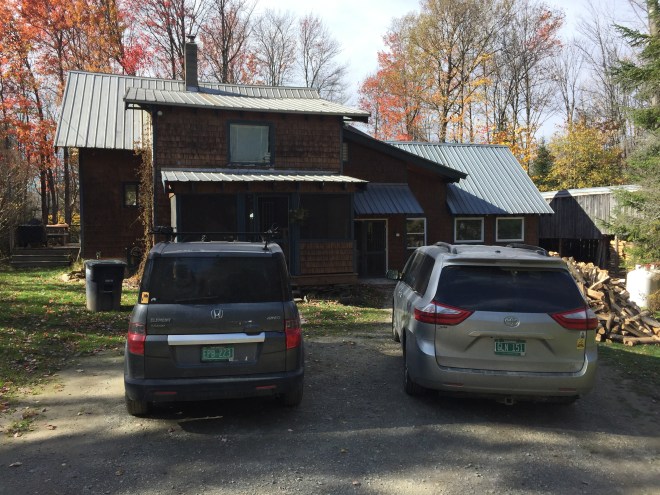
Mill houseThis was the day when my wife officially thought I lost my mind.

It was the day when I woke up and decided to drive 4 hours to that house in the photo.

It’s a house in the middle of the woods in Vermont. I had never spoken to the people who lived there. And based on the fact that they never returned my calls or emails, I knew there was a good chance they didn’t want me to visit.

Obviously, I need to provide some background to explain what compelled me to get behind the wheel and start driving.

It started a few weeks ago when I learned that small, local grain mills had been pretty much eliminated from our country. The most recent statistic I found for the current total is 201 mills in the U.S. The vast majority are the huge, industrial roller mills in the mid-West that mass-produce white flour. But, in my research, I found a handful of bakeries and mills using the kind of artisan equipment that fed America before the Industrial Revolution. And through those craft producers, I was able to figure out that most of them used stone mills made in Austria. So, I assumed that if and when we purchased a mill, it’d be one of those wood-framed, European machines.

But, that assumption changed last week with a phone call from Sara, our friendly grain farmer who I’d just visited in Maine. She told me about a small, home-based bakery in Vermont that was grinding their own flour on a stone mill they built themselves. On their website, I learned that they had built a few similar mills for other bakeries. From the photos, I also discovered that their mills were incredibly beautiful pieces of equipment. The pictures emanated craftsmanship, authenticity, and goodness. Even more, since my concept for what I want to build is based on reviving a local food system, the idea of supporting a local mill builder was a no-brainer. It added another dimension to the dream.

The bakery’s website provided a phone number and email address but, no address. In place of location, the site stated: “closed to public”.

I started calling and emailing every day for a week. I never got a reply.

So, on Thursday, I woke up and decided to just go to the bakery. While it wasn’t on their site, the bakery’s address was online. And after 4 hours (with the final 10 minutes on a windy, dirt road through the woods), I arrived at the house in the photo. I pulled into the driveway, gave myself a little pep talk about destiny and greatness, and then… what happened next I couldn’t make up.

As soon as I opened my car door, a dog started barking and sizing me up like I was a random, uninvited guy on private property that lists “closed to public” on its website. In the moment and in the middle of the woods, that dog was a Rottweiler with attitude. (She ended up being the exact opposite!). I froze and started speaking to her in a high-pitched voice and saying things like “you’re a good doggy”.

It was right then – I was talking to a dog in somebody’s driveway in Vermont – that I thought to myself, “What the hell am I doing?! I should get in the car and drive home.” But, I knew the shame of a 4-hour, empty-handed ride home would be a spirit-crushing defeat. So, I stood there talking to a dog for what felt like an eternity.

Eventually, a guy walked out of the garage and said, “Hi, can I help you?”

I replied, “Sorry to be here uninvited. But, I just drove from Boston because I want to buy a mill.”

“Oh, you must be Jon. Sorry for not getting back to you.”

What happened next was both educational and inspiring. Andrew welcomed me to his home, his workshop where he builds his mills, and the bakery he runs with his wife, Blair. I barely know them but I know they are just like farmers Sara and Matt — incredible people who are dedicated to the purity and integrity of a real craft. They are completely invested in creating goodness by inspiring and preserving a local food system that nourishes others.

I knew who was building our mill.

Week #4: Grain farming

Farm visitSorry for the extreme close-up. That’s me. I’m on a grain farm in Linneus, Maine.

I had done enough reading. I needed to get on a farm where wheat grows, see it for the first time, and meet people who actually know what it is.

So, after serious research and many attempts to connect with them, I scheduled a visit with Matt and Sara, the farmers growing some of the only organic grains in New England. Then, I made the 6 hour drive up 95-North.

Upon arrival, there was no doubt Matt and Sarah thought I was nuts. Most likely, that I’m some crazy yuppie with a mid-life crisis. And that’s exactly what they should’ve thought. I showed up on their farm totally clueless. Even more, I showed up with no business or product (I didn’t even have a job) that related to their farm, crop, and livelihood. All I could tell them was that I had already built a successful food company and that I had a sincere curiosity about grain and a strange feeling that there’s a need for a purpose-driven business rooted in what they do and who they are.

Anyway, Sara and Matt are incredible. They’re a father and daughter tag-team who grow organic and “transitional organic” grains and who built a mill on their farm. They’re among the only local people growing grains and the only ones milling them. Even though I barely know him, my first impression of Matt was that he’s a visionary who is inspired by a higher purpose. He has been growing heritage grains for nearly two decades primarily because he believes it’s the right thing for him to do to help others and the environment. I feel like he’s the real deal on being the change he wants to see.

From our conversation and my own time at college in Maine, I knew that their farm was in the state’s agricultural hub, Aroostook County, where nearly every farmer grows potatoes and broccoli. And while I’m only just learning about the industry, I can kind of tell that the cards are stacked against family farms up there. Farmers appear to be stuck in a no-win economic cycle of growing the same crops, using pesticides, and depleting the value of their land by degrading the health of their soil. Meanwhile, since there’s no real market for grains, there’s no economic incentive for farmers to grow them as cover or rotational crops — keys to biodiversity and soil health.

I knew the term “regenerative agriculture”. Visiting their farm really made me start to understand that wheat can be a catalyst for financial and ecological resurgence of these family farms.

Anyway, it took a 6 hour drive for me to be able to see wheat in person for the first time. And as soon as I did, I was reminded of my own ignorance. I was confused. It was green?! I realized that I only knew wheat through played-out imagery of farm scenes on food packaging. So, I expected Matt and Sara’s wheat to be gold in color and dry in texture. I found the opposite — fresh, green plants. (It was still a few weeks from harvest so it hadn’t dried.) Despite all my recent research, I never really processed the fact that wheat is a grass; that it’s a green plant just like all the other green plants that are good for us. I was completely oblivious to the fact that flour is actually made from a plant just like everything else that grows on farms. So, in Matt and Sara’s field, I saw wheat, touched it, and even peeled off the chaff and ate a bunch of green, chewy wheat berries right off the stalk. They didn’t taste anything like whole wheat bread, crackers, or cereal. And they definitely didn’t taste anything like flour. They tasted like a plant.

It was an important moment for me. I knew I needed to learn more. I knew we needed to figure out a way to work with Matt and Sara.