 A few months ago, there’s no way I’d have ever believed that I could be so happy about sticking my hand in a bucket of flour. And I’d never have believed that I’d be happy about driving to the far corners of New England to pick up wheat berries in Maine and mill them in Vermont.
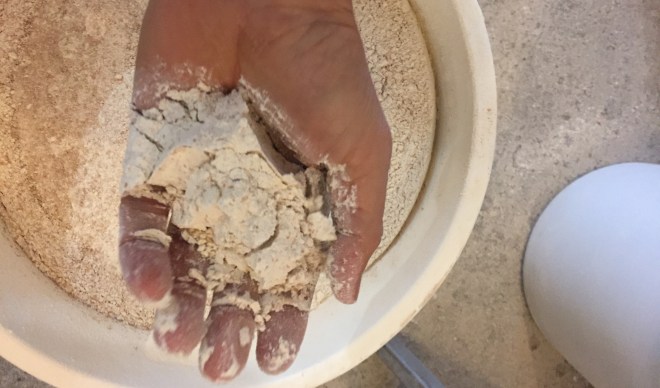
So, that’s my hand full of flour that was just ground fresh on a stone mill. And that means I’m holding the very essence of the food we want to make and the company we want to build.
This flour is special. It’s fresh, real food that needs to be refrigerated instead of sitting on a grocery store shelf or in a kitchen pantry for months or years. It’s perishable food that should be consumed as soon as possible to ensure its nutritional value isn’t diluted.
It looks different – light brown and less powdery than I expected. It smells different – I have no idea what to say it smells like except that it’s a pleasant, earthy odor. (The flour you buy at grocery stores is completely odorless.) And it feels different – moist, a little warm from the friction of the stones, and gritty with little flecks of bran sprinkled throughout the finer particles.
This flour is also special because of how hard it was to get. In stories I’ve already told in this blog, I had to find some of the only organic wheat farmers in New England, convince them I was for real, and head back up to get a sample of the wheat. Then, I essentially had to do the same thing all over again (plus, stare down a dog) to work with the miller.
So, when I stuck my hand in that flour, I was at Andrew’s mill and bakery in Vermont. He had agreed to grind 50 pounds of wheat for me. It took about 45 minutes and was way easier than I imagined. Basically, Andrew just poured the kernels into the funnel at the top of the machine. A few minutes later, flour flowed out of a sleeve at the bottom.
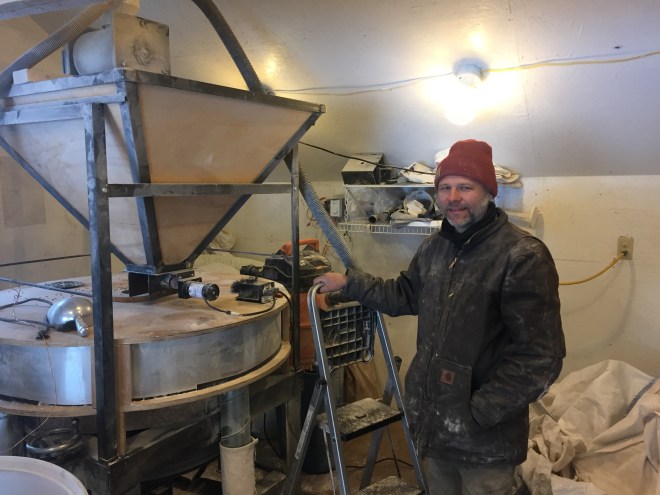
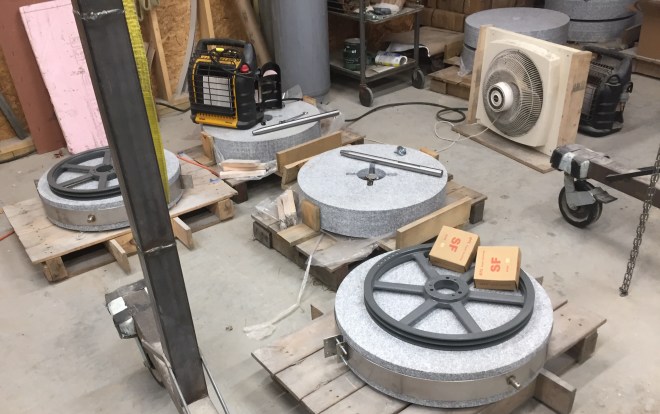
While the mill was running, I learned the basics of operating the machine. I also learned that Andrew’s mills are more than just pieces of equipment. They are an expression of his values. He bakes bread with Vermont wheat that he grinds himself and he builds mills with steel fabricated by a nearby metalworker and stones from a quarry close to his bakery. Then, he has those granite slabs shaped into wheels by a Vermont craftsman who makes gravestones.
As we hung out in his workshop with a bunch of granite wheels on the floor, I could envision a tipping point for local mills and grain. When I asked Andrew about the stones, he informed me that he is building mills for a few other bakeries. He also told me that he wasn’t following up with inbound requests because there were just too many.
Andrew went on to tell me that he had just built his largest mill for Whole Foods. I was blown away. The grocery giant wanted a working display at their new flagship location in Atlanta. While Andrew was concerned that big company bureaucracy may kill the project, it was irrelevant to me if Whole Foods ever used the mill. The fact that they wanted it was total validation that we’re on the verge of a critical shift in our food system. Standing there, I felt certain that I’ve stumbled upon an incredible opportunity to create a business that can help propel that shift.
Right then, I knew there two two urgent things to do. First, turn Andrew’s fresh flour into products that we could taste. Second, sign a contract with Andrew to get started. The next mill he builds needs to be our’s.

 I got next!