
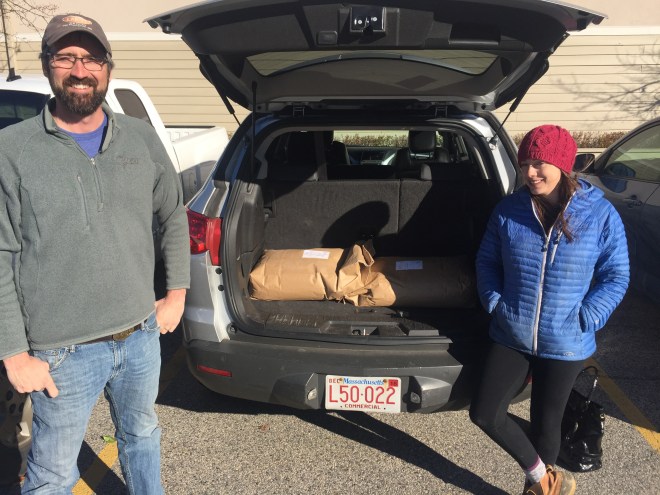
 Getting those brown bags in the back of my car was a really big moment.
On Friday, the Williams, the farmers who I visited in Northern Maine, met me in Portland with 100 pounds of their wheat. That’s Sara and her husband, Marcus, in the photo. They were down from Aroostock County to attend a wedding. So, instead of shipping all that grain, we agreed to make the exchange in-person.
When visiting their farm a couple of weeks ago, I learned they had 100,000 pounds of wheat in storage. I also learned that if stored at the proper temperature and aridity, dried wheat can be held for years. It becomes perishable when you mill it the old-fashioned and the right way: break the seed, expose the germ, and retain both the germ and bran in the flour. (The modern, industrial way removes them and renders white flour as dead starch with unlimited shelf life.)
For a couple of reasons, understanding wheat storage was an important revelation. I didn’t know it could be stored. And I definitely didn’t think that the Williams had that kind of inventory. While I don’t know how much wheat is available in New England, my gut and my basic research tells me that their 100,000 pounds is a major share.
So, getting a sample of that wheat in storage was important. It represented the first step towards the pivotal decision that could make this whole thing real. If I’m going to build a food brand around local wheat, I need to seriously consider writing a check soon. Sara suggested that it can work. She’ll sell me all the wheat in storage, hold it for me while I get my business plan ready, and then, ship down pallets of it as needed. But, she needs a commitment (i.e. a deposit of $25K) by the end of this year. So, I have about 6 weeks to decide if I’ll own enough grain to fill my entire street in Boston (and probably more like my entire block). It’s about a month to decide if I’m making the unorthodox career move to become a New England wheat mogul.
Obviously, before I make that leap, it’s critical that we test Sara’s wheat for flavor and nutrition. It’s got to make for delicious products that people will crave and it has to be game changing for their health. I already know the stats about the incredible differences in fiber, minerals, and vitamins between white flour and unprocessed wheat kernels. But, we need to be absolutely sure that the flour we’ll mill is as nutritious as the analysis documented in books and health reports. That means we need to bake a product with fresh, stone-milled flour and have it tested by a food laboratory. Since I’ve done this many times before with my last company, I’m familiar with the process. But, this time, we need to get even deeper than just calories, fat and protein. We need fiber, vitamins and macronutrients.
First, the wheat berries I put in the back of my car have to be ground into flour. So, I need to pay another visit to Andrew’s house where the kernels can be milled on a stone. As soon as Andrew gives me the green light, I’ll be in the backwoods of Vermont milling my first local grains.

 I got next!