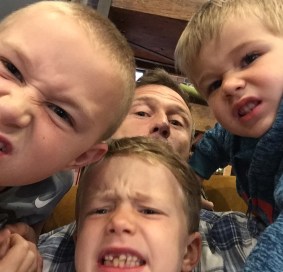
 Sorry for the extreme close-up. That’s me. I’m on a grain farm in Linneus, Maine.
I had done enough reading. I needed to get on a farm where wheat grows, see it for the first time, and meet people who actually know what it is.
So, after serious research and many attempts to connect with them, I scheduled a visit with Matt and Sara, the farmers growing some of the only organic grains in New England. Then, I made the 6 hour drive up 95-North.
Upon arrival, there was no doubt Matt and Sarah thought I was nuts. Most likely, that I’m some crazy yuppie with a mid-life crisis. And that’s exactly what they should’ve thought. I showed up on their farm totally clueless. Even more, I showed up with no business or product (I didn’t even have a job) that related to their farm, crop, and livelihood. All I could tell them was that I had already built a successful food company and that I had a sincere curiosity about grain and a strange feeling that there’s a need for a purpose-driven business rooted in what they do and who they are.
Anyway, Sara and Matt are incredible. They’re a father and daughter tag-team who grow organic and “transitional organic” grains and who built a mill on their farm. They’re among the only local people growing grains and the only ones milling them. Even though I barely know him, my first impression of Matt was that he’s a visionary who is inspired by a higher purpose. He has been growing heritage grains for nearly two decades primarily because he believes it’s the right thing for him to do to help others and the environment. I feel like he’s the real deal on being the change he wants to see.
From our conversation and my own time at college in Maine, I knew that their farm was in the state’s agricultural hub, Aroostook County, where nearly every farmer grows potatoes and broccoli. And while I’m only just learning about the industry, I can kind of tell that the cards are stacked against family farms up there. Farmers appear to be stuck in a no-win economic cycle of growing the same crops, using pesticides, and depleting the value of their land by degrading the health of their soil. Meanwhile, since there’s no real market for grains, there’s no economic incentive for farmers to grow them as cover or rotational crops — keys to biodiversity and soil health.
I knew the term “regenerative agriculture”. Visiting their farm really made me start to understand that wheat can be a catalyst for financial and ecological resurgence of these family farms.
Anyway, it took a 6 hour drive for me to be able to see wheat in person for the first time. And as soon as I did, I was reminded of my own ignorance. I was confused. It was green?! I realized that I only knew wheat through played-out imagery of farm scenes on food packaging. So, I expected Matt and Sara’s wheat to be gold in color and dry in texture. I found the opposite — fresh, green plants. (It was still a few weeks from harvest so it hadn’t dried.) Despite all my recent research, I never really processed the fact that wheat is a grass; that it’s a green plant just like all the other green plants that are good for us. I was completely oblivious to the fact that flour is actually made from a plant just like everything else that grows on farms. So, in Matt and Sara’s field, I saw wheat, touched it, and even peeled off the chaff and ate a bunch of green, chewy wheat berries right off the stalk. They didn’t taste anything like whole wheat bread, crackers, or cereal. And they definitely didn’t taste anything like flour. They tasted like a plant.
It was an important moment for me. I knew I needed to learn more. I knew we needed to figure out a way to work with Matt and Sara.

 I got next!