
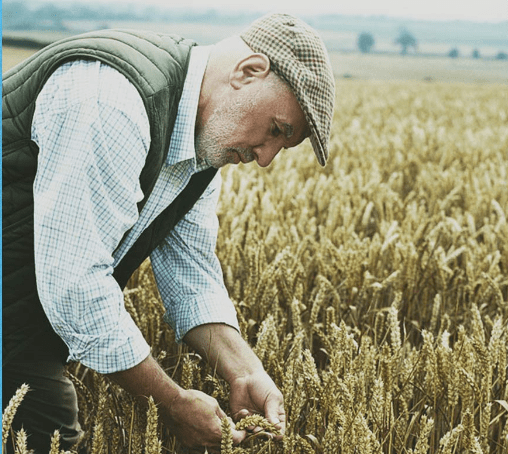
I don’t know anything about grain, especially wheat.
And based on the strange responses and looks I’ve been getting from the people I know, I’m pretty sure that nobody else knows anything either.
I don’t know how grain is grown, where it’s grown, or even what it really tastes like. But, I’ve spent the last few weeks learning a really compelling story. It’s the story of the elimination of a local food system and the inevitable damage that’s caused when we mess with the natural order of things and industrialize our food.
To understand the problem, you need to know how it used to be.
Before the industrial revolution, Americans grew, stored, milled, and ate locally grown and milled grains. Farmers brought their dried wheat harvest to the town miller. There, all three of wheat’s main components were ground together: the fiber-rich bran, the nutrient-dense germ, and the starchy endosperm. It was fresh (i.e. perishable). Back then, flour was a complete food that nourished people, farmers, and local food economies.
But, all that changed with the invention of the roller mill — the machine that made shelf stable white flour. Wheat became empty. Empty in flavor, nutrition, and soul. Flour went from being a living, perishable product to a stable, cheap commodity. Everything consolidated. Those local, sustainable networks of farmers, millers, and bakers vanished. Local mills closed and local family farms stopped growing grains. They were replaced by a handful of giant, industrial monoliths in the mid-West. As a result, wheat and flour became a commodity without a sense of place or connection to a community.
Because of the low cost and indefinite shelf-life of refined grain, we (i.e. Americans) started making and eating a ton of it. And for the last century, it’s been slowly and invisibly killing us in the form of diet related conditions like obesity, diabetes, and heart disease. When you remove the fiber and nutrients, flour becomes basically just starch that your body converts to sugar. And too much sugar causes big problems.
We’re left with this huge contradiction in our food culture. We’re obsessed with health and sustainability. But, since we’re completely detached from grains and mills, we ignore the biggest opportunity to improve what we eat and what it does to our health, environment, and community.
So, my history lesson clearly tells me that the idea of reviving local wheat presents a real opportunity to do something important. And as a business opportunity, it’s exciting because of the comparable success of other commodities that became “craft”. It may be hard to remember, but coffee, beer, and chocolate were all once commoditized ingredients (think Folgers Crystals, Miller Lite, and Hershey’s). Before Starbucks and Sam Adams, they were foods and drinks that had no stories of craftsmanship, no sense of place or origin, and no higher purpose.
There’s no “craft” in wheat and it sure feels like it has to happen.
But, it’s also about more than being the next “craft” food trend. Wheat, when grown and processed properly and with integrity, can change the health of our country. So, we can’t let it be an empty commodity. We can’t keep eating it as oblivious, passive consumers in a broken food system. We need to fix this.

 I got next!