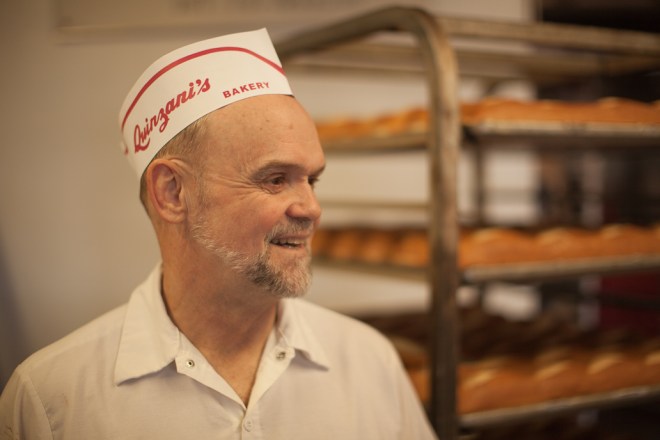
 Quinzani’s Bakery was a 3rd generation bakery in Boston’s South End that was in business for nearly 100 years. It was just a few blocks from our first restaurant. So, from the day we started in 2004, we were proud to buy all our whole wheat burger buns from the three brothers who ran the bakery. And as our business grew across the Northeast, we really liked serving those buns until Quinzani’s closed down a decade later.
Quinzani’s always epitomized “local” food for me. It was a small, family run business. I personally visited the bakery almost every week. I was friends with the brothers who owned and worked in the bakery every day. On top of that, I actually lived around the corner.
But, by the time they closed in 2015, I had begun to wonder about the concept of “local” bread. More specifically, I wondered if it were even possible to serve “local” burger buns that complied with our own vision of “farm-to-table”. Like our veggies, beef, and cheese, could we actually know the people and places growing the ingredients in our buns? Could we have a connection to the people who grew those grains like we did with RobRoy, Steve, and Larry Quinzani?
Early on and before most of our competitors, we learned that connecting consumers to the people who grew and made their food resulted in better food, more loyal customers, more invested employees, and a stronger brand. So, I spent over a decade working to build a restaurant business that made local sourcing a cornerstone in its mission to make “real” food. I visited farms, bakeries, dairies, and even a slaughterhouse (I’ll never do that one again). I communicated the stories of our supply chain to our customers and promoted the importance of local to our teams in the restaurants. And I didn’t stop at just visiting farms, I pushed to start growing our own veggies; to be even more committed to “farm-to-table” by owning a piece of our supply chain. We grew tomatoes on rooftops of our restaurants, teamed up with a local farmer to grow kale hydroponically in a shipping container, and even operated our own farm that was on an island in Boston Harbor.
And it worked. We built a thriving “farm-to-table” restaurant brand. But, that’s exactly the reason why I was thrown for a loop when I started wondering where those Quinzani buns were really “from”. We were supposed to be experts. But, somehow, we never considered that there were farms beyond that local bakery. Even more, I had never seen, touched or tasted wheat before in my life. And until Quinzani’s closed, I had never even thought about it.
So, when I left my company, I knew where I wanted to start — grain. My ignorance on the subject, intuition, and the memory of my beloved, local bakery are all telling me that there’s a systemic problem here. I’m feeling pretty certain that, just like all industrialized foods, it’s a problem that’s hurting the health of communities, its farmers, and consumers.

 I got next!